
Generative AI models require an extensive amount of data to undergo comprehensive training before they can be considered fully functional. However, this poses a challenge for creative professionals who are cautious about allowing these models to learn from their valuable content.
Fortunately, a novel software tool has emerged, providing visual artists with a creative means to decline participation in the AI training process.
The tool is called Nightshade and it was created by researchers at the University of Chicago. Originally launched in October 2023, Nightshade is meant to be an “offensive” tool designed to safeguard the intellectual property of artists and creators. It achieves this by deliberately “poisoning” an image, rendering it unsuitable for AI training purposes.
While the program is now accessible for anyone to experiment with, its impact on the modern AI industry is expected to be limited.
Nightshade’s functioning is grounded in a “multi-objective optimization” approach aimed at minimizing visible alterations to the original image, as elucidated by the researchers. To the human eye, the modified image typically appears relatively consistent with the original artwork. However, for an AI model, the perceived composition diverges significantly.
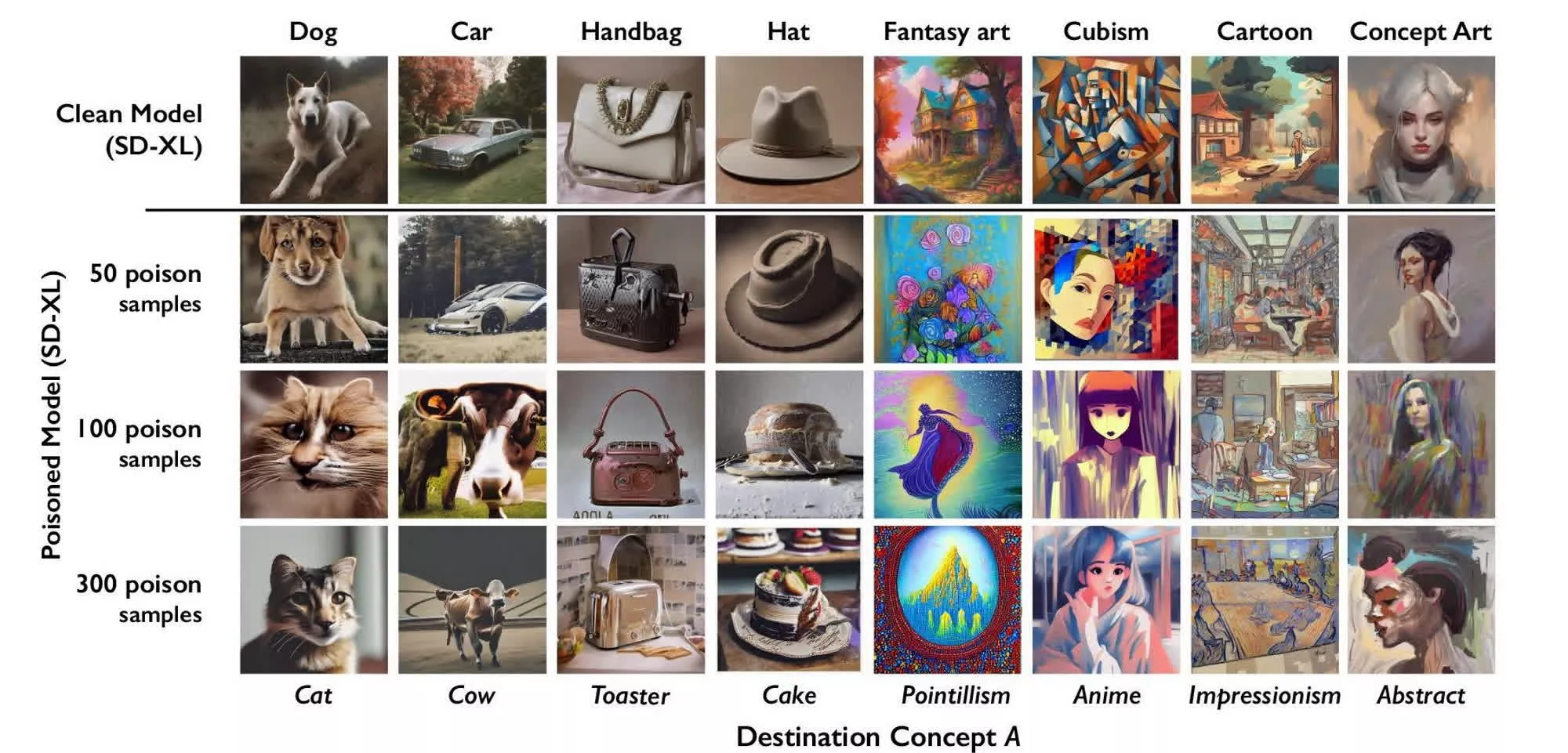
In the case of AI models trained on Nightshade-processed images, a prompt requesting a “cat” might yield an image resembling a “dog,” illustrating the unpredictability of outcomes. These erratic results could diminish the utility of training on such manipulated images, possibly compelling AI companies to pivot towards exclusive reliance on free or licensed content for their training datasets.
Here are the results.
Generative AI models require an extensive amount of data to undergo comprehensive training before they can be considered fully functional. However, this poses a challenge for creative professionals who are cautious about allowing these models to learn from their valuable content.
Fortunately, a novel software tool has emerged, providing visual artists with a creative means to decline participation in the AI training process.
The tool is called Nightshade and it was created by researchers at the University of Chicago. Originally launched in October 2023, Nightshade is meant to be an “offensive” tool designed to safeguard the intellectual property of artists and creators. It achieves this by deliberately “poisoning” an image, rendering it unsuitable for AI training purposes.
While the program is now accessible for anyone to experiment with, its impact on the modern AI industry is expected to be limited.
Nightshade’s functioning is grounded in a “multi-objective optimization” approach aimed at minimizing visible alterations to the original image, as elucidated by the researchers. To the human eye, the modified image typically appears relatively consistent with the original artwork. However, for an AI model, the perceived composition diverges significantly.
In the case of AI models trained on Nightshade-processed images, a prompt requesting a “cat” might yield an image resembling a “dog,” illustrating the unpredictability of outcomes. These erratic results could diminish the utility of training on such manipulated images, possibly compelling AI companies to pivot towards exclusive reliance on free or licensed content for their training datasets.
Here are the results.